Within the framework of a European project, and more specifically for a Marie Skłodowska-Curie Actions (MSCA) initiative, a deliverable is an output that the project partners undertake to produce and submit to the European Commission. These deliverables can take various forms (reports, events, scientific publications, data, etc.).
The Data Management Plan (DMP) is one of the deliverables that must be made public. Find out about the project’s data management guidelines, ethical guidelines and more.
One steering committee and two general assemblies are planned for RP1 (2026–2027).
General Assembly No. 1: Monday, 9 February 2026
Steering Committee No. 1: Tuesday, 5 May 2026
General Assembly No. 2: Monday, 7 December 2026
Steering committees are open only to the representatives of the project’s member organisations.
General meetings are open to all members of the project.
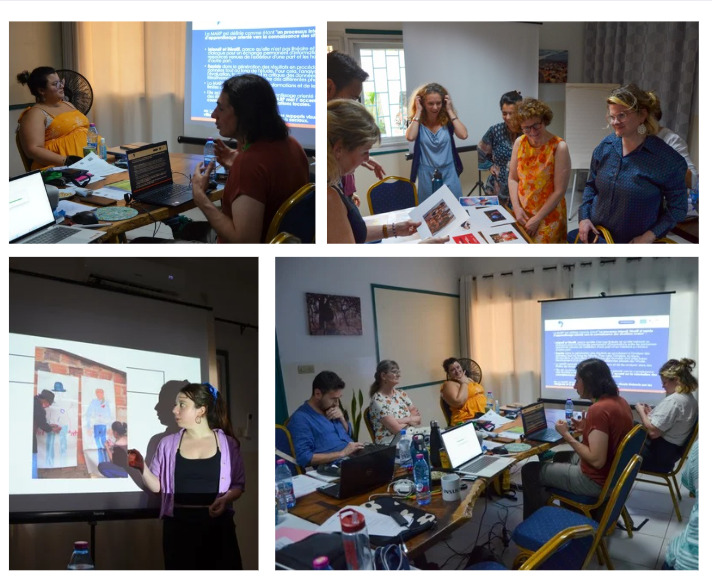
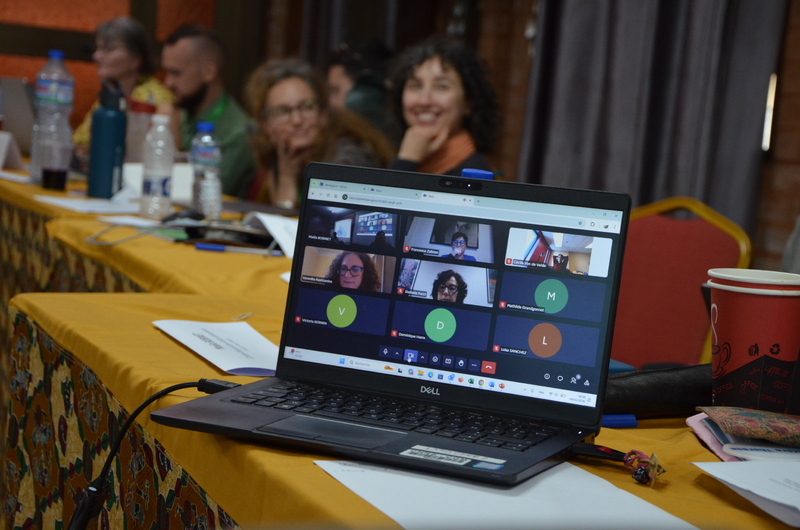
From 11 to 13 February, a 3-day training in scientific mediation through the arts will take place, exploring diverse methodologies and tools. The event is hybrid, hosted in Lomé by Insuco, with online participation available for all project members. Each day focuses on a distinct theme: day one covers "Digital Humanity and Mixed Methods", day two delves into "Fun and Creative Methods", and day three explores "Visual Methods".
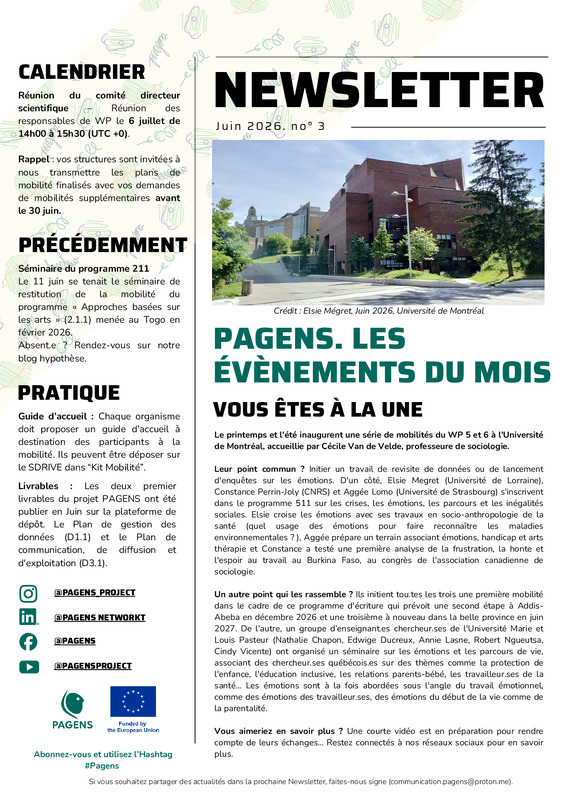
Read the June edition of the PAGENS newsletter. A chance to catch up on the latest project news and find out more about recent exchange programmes. In particular, you’ll find information on the secondments that took place at the University of Montreal in June 2026.
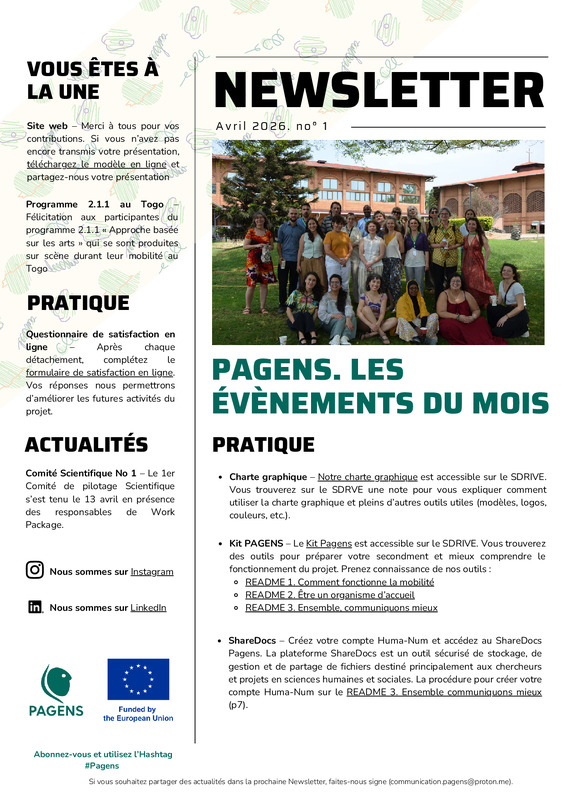
Welcome to the inaugural edition of the Pagens Newsletter your monthly window into Pagens news. This April, we’re thrilled to share stories of progress, collaboration and first tools to get smothly into Pagens project.
Each participant in a mobility programme can use this guide to find out about the methods for collecting communication materials and the communication obligations following their return from the mobility programme.
This README file is available in four languages — French, English, Spanish and Italian — on SDRIVE.
The purpose of this README is to help institutions organise secondments. Here you will find all the essential information you need to prepare for hosting and sending participants on mobility programmes.
This README file is available in four languages — French, English, Spanish and Italian — on SDRIVE.
The purpose of this README is to assist participants with the process of organising their secondment. Here you will find all the essential information you need to prepare for your departure and complete all the necessary administrative procedures. Our aim is to make your mobility experience as smooth and rewarding as possible.
This README file is available in four languages — French, English, Spanish and Italian — on SDRIVE.
Three scientific steering committees are planned for RP1 (2026–2027).
Scientific Steering Committee No. 1: Monday 13 April 2026
Scientific Steering Committee No. 2: Monday 6 July 2026
Scientific Steering Committee No. 3: Tuesday 6 October 2026
Scientific committees are compulsory for work package leaders. Representatives from the project’s member organisations are welcome to attend these meetings.
After three years of preparation and collective work, the PAGENS project – Pathways, Ages, Generations in the North and South – kicked off this week in Lomé, Togo.
Supported by the European Union as part of the Marie Skłodowska-Curie Actions (Horizon Europe), PAGENS brings together 20 partners from 10 countries in Africa, Europe, Canada and Colombia.
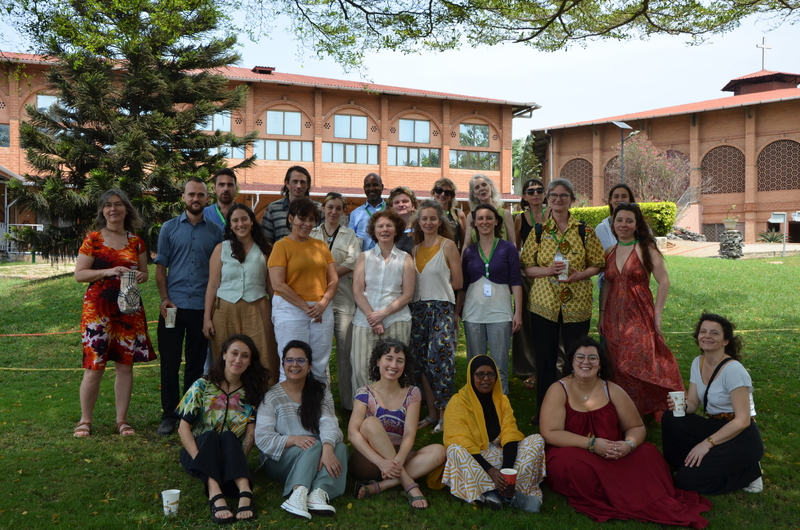
Nearly 30 participants were present for the kick-off meeting, and many other colleagues followed the discussions online. Two days of intense discussions were followed by three days of training at Insuco, devoted to qualitative and quantitative methods, as well as playful, artistic and visual methods – at the heart of the project's innovative approach.
Coordinated by the French Centre for Ethiopian Studies (CFEE) / CNRS, PAGENS is opening up a new dynamic of international cooperation around life courses, generations and movements between the North and South.
PAGENS is part of an open science dynamic, with publication of articles in open access, creation of a life course database and dissemination of results in the form of podcasts, exhibitions and policy briefs. This project strengthens North-South collaborations and encourages dialogue between academic research and field expertise, thereby helping to ensure that issues relating to age and life course are taken into account in the development of public policies.
PAGENS brings together a team of researchers in anthropology, sociology, psychology, history, lawyers, literature, and geography, working in synergy with civil society actors and public institutions. Using participatory methods, innovative visual tools (photography, video, mapping) and comparative approaches, the project produces in-depth but accessible analyses.
Facing global changes - population ageing, increasing mobility, job insecurity, climate change - PAGENS proposes an innovative reading of life transitions, incorporating perspectives from the Global South that are often under-represented. Far from standardised models inspired by the North, the project analyses how individuals navigate between ages, statuses and social roles in a variety of contexts.
The Gender and Development Laboratory at UJKZ (Burkina Faso) has particular expertise in the fields of gender, security studies and intergenerational relations in the Global South. UJKZ is co-lead for WP4. The laboratory will contribute to WP4 through its expertise in research methodologies in contexts of insecurity and in gender-sensitive data collection. Participation in the PAGENS project is therefore essential to enable Burkinabe academics to continue promoting international intellectual exchange.
The University of Montreal (Canada) will play a key role in WP5, drawing on its expertise in the fields of life course studies, intergenerational relationships and emotions. The Department of Sociology hosts the Canada Research Chair in Social Inequalities and the Life Course, with a team of doctoral researchers specialising in the intersection of inter- and intragenerational inequalities and in the methods of collecting and analyzing emotions within life course. The UdeM will host a writing session for WP5 (M6). It also offers innovative dissemination platforms, including the journal Sociologie et Sociétés, the Presses de l'Université de Montréal, podcasts and graphic novels. In addition, the UdeM is directly linked to applied research centres such as CREMIS, where the ‘Ages and Generations’ cluster promotes collaboration between university research, public policy and practical interventions.
The AAU and its Institute of Ethiopian Studies (IES) are particularly involved in WP5, co-led by Takele Merid. Its teams contribute their expertise in historical and archival research and make their library and archival collections available. IES researchers are also particularly interested in gender issues and are therefore participating in WP6.
IRICA (Djibouti) is a private research and expertise association specialising in research methodologies and responses to public demand. In doing so, IRICA actively contributes to bridging the gap between research and expertise, and plays a key role in disseminating knowledge to decision-makers (WP3). IRICA will host researchers as part of WP4 and WP6 and will share its in-depth knowledge of the Djiboutian context with them. In return, IRICA members will be hosted by partner institutions.
IFSRA is a research association based in Burkina Faso. It was created as a result of an initial desire among Insuco researchers to formalise the links between their studies and academic research. Its strong roots in the field enable IFSRA to produce an understanding of specific topics in a variety of African contexts. IFSRA draws on the network of Insuco offices and operates in North Africa, West Africa, Central Africa and East Africa. IFSRA promotes research through specific partnerships, by conducting joint activities with national and international research organisations, providing scientific supervision for students and sharing an understanding of research through courses, conferences and co-authoring articles.
IFSRA will be particularly involved in dissemination (WP3) and will also participate in WP2 (2.1.1 and 2.2.1) and in the fieldwork of WPs 4, 5 and 6.
ICSI (Insuco Center for Social Innovation) is a center of critical thinking for action. At ICSI, we weave bridges between social science research and territorial learning to anticipate and sustainably accompany major global transitions, motivate informed decision-making by multiple actors, and catalyze collective action processes.
Insuco Madagascar, a subsidiary of Insuco Intl, will provide researchers with its experience as a consulting firm and its understanding of public development policies. It has a wide range of tools and methodologies for socio-economic studies and mapping tools, which experienced and young researchers will be trained in during their mobility at Insuco Madagascar. Researchers will have the opportunity to familiarise themselves with social sustainability studies and stakeholder consultation methods, which are particularly useful for conducting participatory research.
Insuco Madagascar will participate in WP2 (2.1.1 and 2.2.1). Mobility (to/from) all organisations linked to Insuco will help to develop links between research and expertise (Obj.3).
Insuco Togo, a subsidiary of Insuco Intl, will provide researchers with its experience as a consulting firm and its understanding of public development policies. It has a wide range of tools and methodologies for socio-economic studies and mapping tools, which experienced and young researchers will be trained in during their mobility at Insuco Togo. Researchers will have the opportunity to familiarise themselves with social sustainability studies and stakeholder consultation methods, which are particularly useful for conducting participatory research.
Insuco Togo will participate in WP2 (2.1.1 and 2.2.1) and will host the project kick-off meeting. Mobility (to/from) all organisations linked to Insuco will help to develop links between research and expertise (Obj.3).
The Insuco Group, led by Insuco Intl, is a consultancy firm providing specialist services covering all social aspects of extractive, infrastructure and institutional projects in Africa, Latin America and Asia. Our aim is to promote sustainable partnerships between all local stakeholders. We offer our clients effective, operational and pragmatic approaches based on a thorough understanding of their priorities and the local context. Our multidisciplinary and intercultural teams combine both high-level expertise and in-depth knowledge of the field. Our networks and our policy of continuously strengthening local capacity help us both to optimise our activities and to ensure the consistency of our actions. Our research and development department, focused on knowledge management, information systems and tool development, ensures a continuous level of excellence, enabling us to remain at the forefront of innovation in the social sciences.
Insuco Intl and its subsidiaries Insuco Togo and Insuco Madagascar will primarily participate in WP2, WP5 and WP6.
The University of Aix-Marseille (France), through its Mediterranean Centre for Sociology, Political Science and History (MESOPOLHIS), possesses multidisciplinary expertise in sociology, political science, psychology and history, with several key research areas focusing on the Euro-Mediterranean region. MESOPOLHIS also covers a wide range of approaches. Firstly, particularly in terms of quantitative methodologies, thanks to significant expertise in database management, as well as proficiency in various analysis software programmes (Excel, R, SAS, Modalisa), and the availability of institutional support (the DemoMed Observatory and the University Data Platform) and human resources (researchers and research engineers). Secondly, it also specialises in innovative, creative and visual multimodal qualitative methodologies. For the past two years, the laboratory has supported the METISS seminar – ‘Creative Methods in Humanities and Social Sciences Research’, was awarded the CIVIS Alliance TRACES project “Trajectories, Resonances, Creative Approaches, Knowledge, Inquiry, Shared Knowledge” (2025–26), and collaborates with the “Images and Societies in the Mediterranean” platform hosted by the MMSH. Given this expertise, MESOPOLHIS is particularly well-positioned within WP2, and more specifically on innovative methodologies (T.2.2); it also makes a significant contribution to WP5 and WP6 through its expertise in life stages, vulnerability, violence, gender, social policy and demography, as well as in quantitative approaches and fieldwork. both on the themes of these WPs, with expertise in life stages, social policies, vulnerability and age’s passage, as well as on mobilities, migrations and crises.