Institution:
Université Marie et Louis Pasteur (UMLP), Laboratoire C3S in Besançon (France)
Field of research:
Sociology of Education: the conditions and effects of shared parenting on academic and educational attainment
Publications & projects: -
Institution:
Institut de Recherche Indépendant de la Corne de l'Afrique (IRICA) in Djibouti (Djibouti)
Field of research:
Parent-adolescent relationships in a context of social change ; Ageing in the local area
Publications & projects: -
Institution:
Aix-Marseille Université - MESOPOLHIS (UMR 7064) in Aix-en-Provence (France)
Areas of expertise:
Old age and ageing, stages of life and life courses, vulnerabilities, lifelong learning, digital literacy, family support, health and chronic conditions.
Publications & projects:
Projet QUIT-EHPAD – IRESP-CNSA (2025-2027) Pourquoi quitter les EHPAD : Analyse des departs et des reorientations professionnelles des soignantes. Coord. Scientifique Jingyue Xing. 4 partenaires : Université de Lille, Université de Bretagne Occidentale, ITEV et Aix-Marseille Université. Responsible scientifique pour AMU. https://iresp.net/projets_finances/pourquoi-quitter-les-etablissements-dhebergement-pour-personnes-agees-dependantes-ehpad-analyse-des-departs-et-des-reorientations-professionnelles-des-soignantes/
Projet européen TRACES – Alliance CIVIS “Trajectoires, Résonances, Approches creatives, Croisement des savoirs, Enquêtes collaboratives et Savoirs partagés” (2025-26) – coord. Par Aline Bingen. 3 partenaires : Université Libre de Bruxelles (Belgique), Université Cheikh Anta Diop (Sénégal) et Aix-Marseille Université (France). Responsable scientifique pour AMU
ANR ELVIS – Etude Longitudinale sur le Vieillissement et les Inégalités (ANR-20-CE41-0015).
Membre du consortium, rattachée à l’équipe lilloise et l’axe sur les usages différenciés du numérique chez les personnes âgées (2021-2025). https://www.statistiques-recherche.lassuranceretraite.fr/decouvrir-le-projet-elvis/
Institution:
Université Marie et Louis Pasteur, Laboratoire de Sociologie et d'Anthrologie (LaSA), Besançon (France)
Areas of expertise:
Social anthropology of the life stages, gender and health: life courses, public policy and the menstrual cycle.
Publications & projects:
Passages d’âges et maladie chronique : trajectoires de soins des 12-21 ans atteints de diabète de type 1 ou d’asthme (PASMAC) 2017-2021 Recherche financée par l’IRESP/INSERM
Mémoires menstruelles : échanges intergénérationnels (MeMo) 2024-2025 Recherche financée par DREETS Bourgogne Franche-Comté et CRIT UMLP
Frères, sœurs et situations de handicap au long du parcours de vie (FRATRIE) – 2025-2027 Recherche financée par Caisse Nationale d’Allocation familiale Université Marie et Louis Pasteur / Université de Strasbourg
Institution:
University of Eastern Piedmont (UPO) – Department for Sustainable Development and Ecological Transition (DISSTE), Italy – Vercelli
Areas of expertise:
Administrative law (substantive and procedural aspects); digitalisation of public administration; environmental law; governance and regulation of environmental policies.
Publications & projects:
CIMELIA – Ecological Contracts and Sustainable Co-Administration of Natural Resources (2026–today)
Speak4Nature – Interdisciplinary Approaches to Ecological Justice (2023–today)
CybeR-GoPA – Cybersecurity Risk Governance in Public Administration (2023–2026)
Institution:
University of Eastern Piedmont (UPO) – Department of Law and Political, Economic and Social Sciences (DIGSPES), Italy – Alessandria
Area of expertise:
Ecosocial approaches and sustainability in social work, participatory and collaborative practices, the management of social services and critical social work theory, with particular focus in anti-oppressive approaches and posthuman philosophy.
Publications & projects:
ECOSOW – Social Work and Sustainable Local Development in Italy (PRIN 2022) (2023–2025)
CRIMAS – Critical Managerialism and Social Justice in Social Work (University of Eastern Piedmont Research Project)
Institution:
University of Eastern Piedmont (UPO), Department of Law and Political, Economic and Social Sciences (DIGSPES), Italy – Alessandria
Areas of expertise:
Community and eco-social work, supervision, migration and ageism in healthcare, as well as anti-oppressive practice and service-user involvement, through the analysis of professional practices
Publications & projects:
Age-It – Ageing Well in an Ageing Society (PNRR), Spoke 7 – Cultural and Political Dimensions of Ageing Societies, Task 4 – Ageism, Prejudice and Discrimination. (2023–2026)
ECOSOW – Social Work and Sustainable Local Development in Italy (PRIN 2022) (2023–2025)
The End of the Beginning: Research on Social Work with Asylum Seekers during the COVID-19 Pandemic in Northern Greece and Southern Italy (International research project) (2020–2022)
Institution:
University of Eastern Piedmont (UPO), Department of Law and Political, Economic and Social Sciences (DIGSPES), Italy – Alessandria
Areas of expertise:
Protection of social rights, with a particular attention on healthcare; the relationship between law, politics, and science; biolaw; democratic participation; and regional and local autonomy, with a focus on the relationship between levels of government
Publications & projects:
Age-It – Ageing Well in an Ageing Society (PNRR), Spoke 10 – Ageing and Policies (2023–2026)
IMPROVE – The Impact of New Prenatal Genetic Tests on the Protection of the Right to Health in the Italian National Health Service (UPO Research Call 2022)
The Constitutional Right to Health and the Organisation of Healthcare after the Pandemic Emergency (Italian Ministry of University and Research – MUR, Decree No. 2791, 25 November 2021)
Institution:
University of Eastern Piedmont (UPO), Department of Law and Political, Economic and Social Sciences (DIGSPES), Italy – Alessandria
Areas of expertise:
Migration and gender studies, urban sociology, and territorial welfare
Publications & projects:
PRISMA – Participation and Integration of Migrants in Small and Medium Towns: analysing access and accessibility to social and health services through structures, networks and narratives (PRIN PNRR 2022 – National Research Projects of Relevant Interest, Ministry of the Interior) (2024–2026)
Reinforcing Multi-Level Policy Coordination for Integration in Italy (Council of Europe – co-funded by the European Union) (2024–2025)
PISTE – Participation in Small- and Medium-Sized Towns: Experiences, Exchanges and Experiments (Asylum, Migration and Integration Fund – European Commission) (2021–2023)
Training course for Programme 5.1.1 on Emotions
In-person at the CFEE and online (bilingual: French and English), from 2.00 pm to 6.00 pm
A one-week training course on Programme 5.1.1: ‘Collective Writing Sessions: Emotions: Life Journeys, Social Inequalities and Generations’. The course will be organised over five half-days (afternoons). The aim of the course is to address the issue of emotions from the perspective of crises.
Training under Programme 5.2.1 on visual approaches
In-person at the CFEE and online (bilingual: French and English), from 1.00 pm to 5.00 pm
A one-week training course under programme 5.2.1: ‘Training through fieldwork, comprising a week of photography training followed by a field assignment’. The course will be organised over five half-days (afternoons).
The aim of the course is to provide an introduction to the use of photography in research, combining theory with practical application.
Photos Alexandra Merienne : Togolese dancers and researchers during the dance performance.
Programme 2.1.1 Training through fieldwork - Implementation Art-Based approach
Photos Audrey Dessertine: ‘Photolangage’ workshop run by the Ethnoart association
Programme 2.1.1 Training through fieldwork - Implementation Art-Based approach
Photos: Constance Perrin-Joly
From left to right: pottery at the craft village, an interview with a potter, and two potters in Tsevié.
Programme 2.1.1 Training through fieldwork - Implementation Art-Based approach
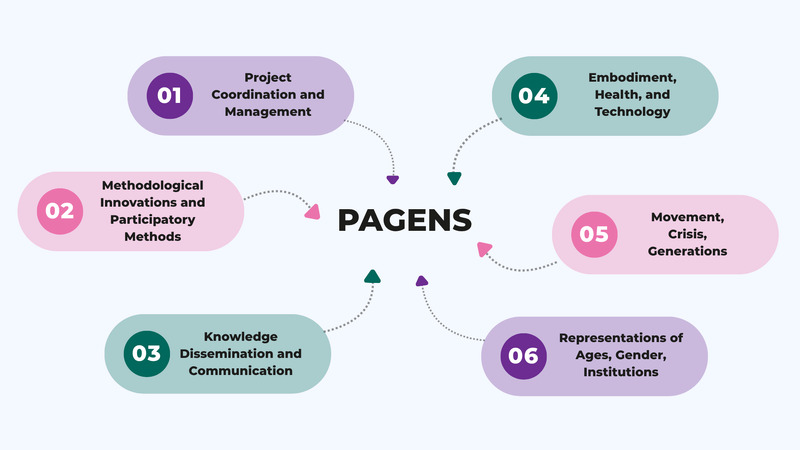
The PAGENS project is structured into six work packages:
Work Package 1 Project Coordination and Management
Work Package 2 Methodological innovations and participatory methods
Work Package 3 Knowledge Dissemination and Communication
Work Package 4 Embodiment, Health, and Technology
Work Package 5 Movement, crisis, generations
Work Package 6 Representations of ages, gender, institutions
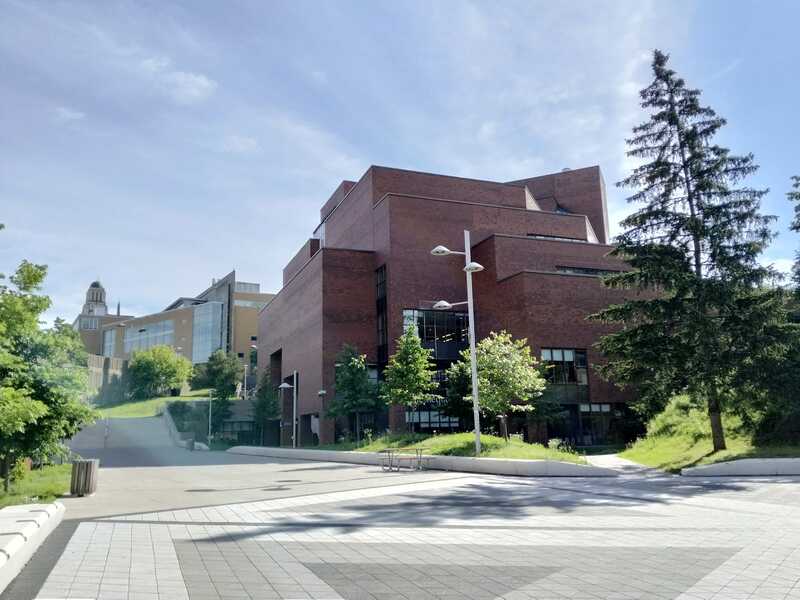
From Monday 15 June to Friday 19 June 2026 – Seminar on ‘Emotions, feelings, perceptions and life courses’, held in Canada at the University of Montreal and online. This event forms part of programme 6.2.2, ‘Practical training: social protection, family policies and social work’.
This five-day seminar will be conducted in French.
Take part in a training course run by the French National Centre for Scientific Research (CNRS) on ethical and data management issues. This training course will be delivered in English.
Participez à une formation menée par le Centre National de la Recherche Scientifique (CNRS) sur les questions d'éthique et de gestion des données. Cette première formation sera proposée en français.
The communication, dissemination and exploitation plan is one of the public deliverables of Work Package 3. It includes, in particular, the annual strategy, the editorial calendar and the performance indicators.